


Follow-up prospecting is vital because not everyone is suitable or at the right stage to use your product or service.
By taking the time to identify and research your ideal customer, you’re much more likely to reach and convert the people most likely to buy from you.
Audit current performance
Before you start planning for the future, find out what your sales process is like today. Auditing your current practices is essential to determine where you stand, and how productive your sales are.
To carry out this sales performance audit, answer these questions:
- How do new prospects find you?
- What are your current customers like (profession, age, etc.)?
- How many deals do you close per month?
- Why don’t prospects become customers? Determine a potential prospect’s “reasons for loss”.
- What is your conversion rate? Calculate it simply by comparing your total number of prospects with the number of new customers over a given period (e.g. a year).
- What are your sales per month and per customer?
- What’s your profit per customer?
- How much time do you spend with each customer?
By cataloguing these practices, you’ll inevitably start to notice areas for improvement and identify weaknesses you need to correct to increase sales productivity. It also gives you a basis for seeing whether the changes you make are having a real impact.
Identify key indicators and set yourself (achievable!) time-bound targets.
Define your sales funnel / tunnel
It’s called a funnel because of the shape it takes at each stage. At each stage, the number of visitors will decrease, because not all prospects will convert.
These stages correspond to the path that will enable you to transform the simple suspect into a customer: at the top, there will be all your suspects or prospects, and this number of contacts will decrease at each stage, until only the customers remain.
It’s up to you to determine which steps your prospects need to go through in order to become customers. This will enable you to identify the sticking points and show you that the majority of prospects stop at certain stages.
If all your contacts stop at the same stage, you may be able to deduce that something is wrong with them. Perhaps you’re calling them back too early or too late? Or maybe you’re not anticipating the brakes long enough to discourage them from continuing with their purchase?
By asking yourself these kinds of questions, you can then improve this specific part of your sales process to convert more leads.
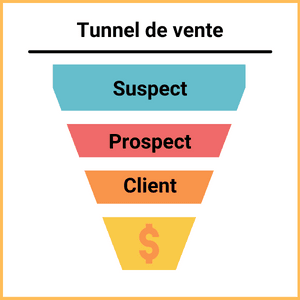
For example, at Moovago we have divided our sales tunnel into several stages:
1. We attract prospects through advertising and free content on the Internet and on Linkedin.
2. These prospects use our site to find relevant information.
3. Some of them are interested in our application.
4. They try the Moovago application.
5. They become users of the Moovago application.
6. They become Moovago ambassadors and tell their friends and family.
7. We carry out regular checks to understand the new needs of current customers.
These stages will be very different depending on your company’s field of activity and goals. Once you’ve done this, you’ll be able to classify your prospects according to the stage they’re at, so you can carry out better sales follow-up and analyze blockages.
Once your prospects have become customers, you can also create recurring tasks so that you can call them to find out how things are going, and if they need any new products or services. New requests from existing customers can be tracked using business tracking or quotation tracking.
It’s important to identify and understand the new demands of existing customers, so that they don’t go away. An existing customer is much easier to keep than a new one is to convince.
Use the right prospecting follow-up software
Many types of company in a wide range of sectors have difficulty keeping track of their prospects and customers, or are growing so fast that their sales follow-up suffers. Others have no clear, defined way of tracking sales. Both new and established companies can face these problems.
Prospect tracking software can be the solution to these challenges… and many more! If your business needs to build better relationships with prospects, manage lead interactions and improve sales, you’ll benefit from sales follow-up software.
This software is also known as CRM software.
Of course, not all CRM software is suited to your needs.
At Moovago, we’ve developed a software/application specialized in sales follow-up for traveling salespeople.
You’ll be able to create and optimize routes directly in the cloud-based application.What’s more, this French application brings together all the tools used by sales reps: reports, reminders, reminders, tasks, appointments and sales revenue.
Thanks to reminders, you’ll know which companies to visit, and you’ll also be able to organize your route according to sales revenue opportunities.
Find out more about this type of software in this article: CRM software examples.
Qualify your prospects
The BANT method and, more recently, the GPCTBA/C&I method help you qualify your potential customers. You’ll work with certain prospects rather than others, because they’re more likely to become your customers, so you can prioritize your follow-up prospecting.
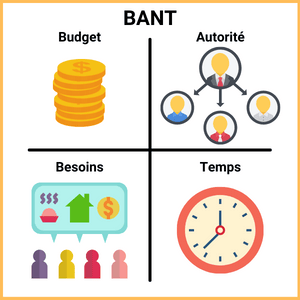
BANT method
The BANT method is an effective way of prioritizing your prospects. This technique is based on a simple observation: the more a prospect meets your requirements – your idea of the ideal customer– the more he or she will need to be prioritized.
Generally speaking, a good prospect combines 3 of the following 4 conditions:
Budget: Can your prospect afford your product or service? Even if you’re the best salesman in the world, you’ll have a hard time selling a private jet to the average person. So don’t waste time on prospects who can’t or won’t pay the price for your products.
Authority: Is your prospect the decision-maker for this purchase? Detecting whether your prospect is a trainee or the company director will change a lot of things for you. You need to focus your time on the prospect who can choose to buy your product or service.
Need: What are your prospect’s needs? To do this, you need to get in touch with the prospect and really understand their needs, so you can offer them an experience that’s tailor-made for them. If you can’t meet the prospect’s needs, stop wasting time conversing with them.
Time: When does your prospect need the product or service? If your prospect needs your product several years from now, then you can focus on the prospect who needs it now.